
Maestro
Let Maestro take flight, follow the parrot and rising multiplier before the round comes to its sudden conclusion.
Game Overview
Maestro by GalaxsysOur verdict
Maestro Review
Released on 20th November 2023, Maestro is a multiplayer crash game from Galaxsys. Its animated parrot takes centre stage while the multiplier rises, leaving players to collect before the flight ends.
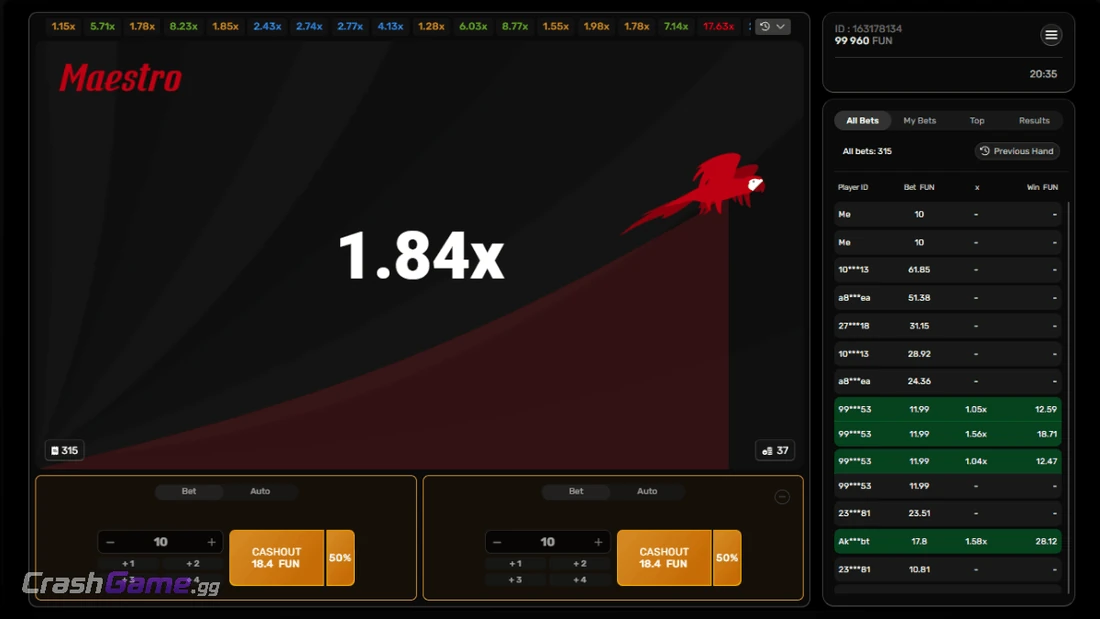
Two betting panels support separate stakes and collection decisions within the same round. Players can also use Auto Bet or settle 50% of an active return while allowing the remaining portion to continue.
Maestro has a published RTP of 98% and a maximum multiplier of 700,000x. Betting limits can vary between operators, with commonly available versions accepting stakes from 0.10 to 100.
How to Play Maestro
Maestro opens a short betting period before the parrot begins its next journey. Place one or two wagers and collect while the round remains active.
Select a stake: Enter the amount on the first betting panel. Enable the second panel if another wager is required.
Place the bet: Confirm the wager before the countdown reaches zero.
Follow the parrot: The character moves through the scene while the multiplier rises from its opening value.
Collect the return: Press Cash Out before the sudden stop to receive the current multiplier applied to the stake.
Collect half: The 50% Cashout control settles half of the available return and leaves the remainder in play.
Lose an active wager: Any unsettled amount is lost when the round ends.
Both betting panels are connected to the same stopping point. Each can use a different stake or be collected at a different time, but they do not create separate multiplier results.
Auto Bet places subsequent wagers according to the selected settings. Manual collection remains available when a round is active.
Recent results provide a record of completed multipliers. They do not indicate when the parrot’s next journey will end.
Maestro - Design
Maestro starts each round with a sleek animation. The transition into the action is smooth and the art style feels considered.
Choosing a parrot was an interesting decision. Crash games are overflowing with aeroplanes, rockets and spaceships, so even this relatively modest character change gives Maestro a more recognisable identity.
Character animation provides a little personality during the flight. The parrot’s movement is more appealing than watching an anonymous line travel across a graph, and the new-round sequence creates an initially polished impression.
Betting information is arranged cleanly beneath the central animation, with each wager clearly separated from the other.
The interface also handles 50% Cashout without making the active wager difficult to interpret. Players can see that part of the return has been settled while the rest continues with the round.
Our difficulty with Maestro is that the presentation never develops beyond that first impression. The launch looks sleek, but the journey itself is extremely uneventful.
That makes the gameplay feel surprisingly dull. Maestro uses the crash format in its most basic form, and the appealing artwork cannot disguise how little is happening after the opening animation has finished.
Maestro looks somewhat elegant but it simply feels much emptier to play than its polished introduction promises.
Maestro - Win Potential
Maestro has a published RTP of 98%. The corresponding theoretical house edge is 2%, placing it towards the more competitive end of the crash category.
Its maximum multiplier is 700,000x. The probability of reaching the upper values becomes extremely small, and most completed rounds will finish far below the advertised limit.
Collecting early requires the parrot to survive for less time but produces a smaller return. Waiting for a higher multiplier increases the available payment and the chance that the wager will be lost first.
The two betting panels can use different collection points. One bet could be settled during the early part of the journey while the other remains active, though both are still linked to one stopping multiplier.
The 50% Cashout feature provides another way to divide exposure. It secures half of the current return and keeps the remainder attached to the continuing flight.
Any portion left active can still be lost. Partial collection changes the amount exposed rather than improving the underlying probability of the round continuing.
The 98% RTP is the strongest practical argument in Maestro’s favour. Its mathematics are considerably more interesting than its subdued presentation.
What we like
- Sleek opening animation gives a strong first impression
- Galaxsys have tried something different and out of the ordinary
- Its 98% RTP and 50% Cashout are strong offerings
What we don't like
- The gameplay becomes very dull, very quickly
The bottom line
Maestro initially appears to be one of Galaxsys’ more stylish crash games, but that promise fades once the multiplier begins moving. The surroundings barely change, the parrot shows little personality and the central animation quickly becomes repetitive, leaving the game feeling unusually stripped back.
The 50% Cashout feature and two betting panels provide useful flexibility, while the 98% RTP is genuinely competitive. Those strengths make Maestro mathematically attractive, but they cannot compensate for a presentation that offers few reasons to feel invested in the journey.
Frequently Asked Questions
Maestro has a published RTP of 98%, producing a theoretical house edge of 2%.
The maximum multiplier is 700,000x, although values near the ceiling require exceptionally rare extended rounds.
Yes. Maestro supports two wagers with separate stakes and collection decisions, but both follow the same parrot journey and stopping multiplier.