
Need for X
Swerve across the road, hunt down warning boxes and discover whether the next collision upgrades your multiplier or writes off the entire run.
Game Overview
Need for X by OnlyplayOur verdict
Need for X Review
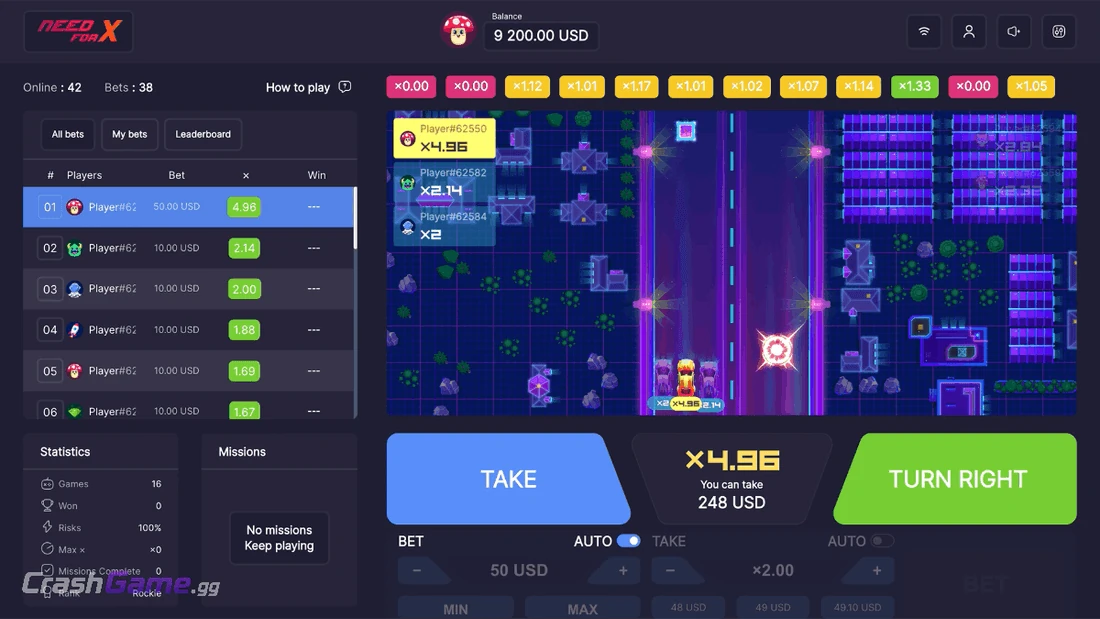
Released on 23rd February 2023, Need for X is an interactive Infinity Play multiplier game from OnlyPlay. Instead of following a shared aircraft, players control a car travelling along a two-lane road and decide whether to collide with the mystery boxes ahead.
Each box contains either a multiplier or a bomb. A successful collision increases the accumulated value and allows the journey to continue, while a bomb destroys the car and removes any return that has not been collected.
Need for X has an RTP of 95% and medium volatility. Its Infinity Play structure has no fixed progression limit, allowing an individual journey to continue for as long as the player avoids a bomb or chooses not to collect.
How to play Need for X
Need for X is less immediately familiar than a conventional crash game, so reading the rules and tutorial before placing a wager is strongly recommended.
Choose the stake: Set the amount before entering the road. Need for X supports one active wager per journey.
Start driving: Confirm the bet and identify your car among the traffic travelling along the two-lane route.
Change lanes: Use the left and right controls to move towards a mystery box or avoid it.
Hit a box: Colliding with a box reveals either a multiplier or a bomb. Multiplier values are applied to the current coefficient.
Continue or collect: After a successful box, decide whether to search for another value or use Take to settle the accumulated return.
Avoid a bomb: Discovering a bomb destroys the car and ends the journey without paying the uncollected amount.
Driving past every box can theoretically keep the journey running indefinitely. It does not create a profit, however, because the multiplier only develops when the car interacts with the boxes.
Successful multiplier values compound rather than merely being added together. A 1.5x box followed by a 2x box, for example, produces a combined coefficient of 3x.
Automatic instructions can place wagers and collect at predefined values. The player still needs successful boxes to reach the selected coefficient.
Need for X also includes missions, player progression and a leaderboard. These provide longer-term objectives around the road journey without revealing what is hidden inside the next box.
Need for X - Design
We'll be honest, Need for X did confuse us at first. Moving a car left and right appears straightforward, but the game does not initially make it obvious why anyone would deliberately steer into an object marked with an exclamation point (we'll also admit we did not read the instructions before playing, which is sin!).
The usual instinct is to avoid hazards. Here, every potential return is hidden inside one, and refusing to collide with anything leaves the car driving without increasing the multiplier. The concept only began to make sense after we had actually read the rules carefully.
Once we understood that relationship, the game became considerably more interesting. Choosing a lane creates a proper interaction before each result instead of asking the player to watch an animation and wait for a Cash Out button.
The road has a colourful futuristic appearance, with illuminated lanes, traffic and warning boxes keeping the route active. The car moves smoothly between positions, and successful collisions provide immediate feedback.
The possibility of avoiding every box creates an unusual pause in the risk. A player can keep travelling without encountering a losing result, although doing so also means the game is making no meaningful progress.
We went from wondering what Need for X wanted us to do to becoming genuinely engaged by its premise. It asks more of a new player than most crash games, but there is an actual idea behind that additional complexity.
Need for X - Win Potential
Need for X has an RTP of 95%, producing a theoretical house edge of 5%.
Interestingly, OnlyPlay lists its maximum exposure as “any.” The Infinity Play mechanic does not impose a conventional headline multiplier, although extremely long sequences of successful boxes become progressively less likely.
Every multiplier box compounds the active prize. This can make the available return accelerate quickly once several successful collisions have occurred.
A box can also contain a bomb. The entire uncollected return is lost when that happens, regardless of how many multipliers were found earlier in the journey.
The lane controls introduce timing and decision-making without changing the random contents. The player chooses when to interact with the risk, while the game determines whether that interaction succeeds.
Missions and account progression may provide separate rewards depending on the casino configuration. They do not improve the probability that the next mystery box contains a multiplier.
Is Need for X Provably Fair?
OnlyPlay presents Need for X as supporting its provably fair technology. The system uses cryptographic data to commit to concealed results before they are revealed.
The relevant hash and seed information can be examined through the game’s fairness or history interface. Reproducing the calculation confirms that the underlying box result was not changed after the wager had been placed.
Infinity Play means the information may be presented differently from a conventional shared round with one stopping multiplier. Players should follow the verification procedure supplied inside their casino’s build.
What we like
- Lane-changing controls create more interaction than conventional games
- Infinity Play allows each journey to continue without a fixed multiplier ceiling
What we don't like
- Its 95% RTP is a bit disappointing
The bottom line
Need for X takes time to understand, as aiming for warning boxes initially feels counterintuitive. Once its rules become clear, each box represents the choice between increasing the multiplier and ending the run, giving familiar crash gameplay a much more interactive presentation.
Choosing a lane does not influence what is hidden inside the box, but it makes the player responsible for triggering each new risk. Clearer instructions would improve the opening experience, yet Need for X ultimately rewards that initial patience with an inventive and memorable approach to the crash decision.
Frequently Asked Questions
Need for X has an RTP of 95%, equivalent to a theoretical house edge of 5%.
OnlyPlay lists the maximum exposure as “any.” Infinity Play has no conventional fixed ceiling, although every additional box introduces another chance of finding a bomb.
Steering determines whether the car collides with or avoids a box. It does not control the generated result hidden inside that box.