
Pingwin
Read the road ahead, collect between obstacles and guide a monochrome penguin through a crash game that rewards sharp timing as much as nerve.
Game Overview
Pingwin by XUP StudioOur verdict
Pingwin Review
Released in 2026, Pingwin is XUP Studio’s obstacle-based crash game. A penguin travels along a monochrome route while the multiplier increases, with clearly visible obstacles identifying every point at which the round could end.
The penguin cannot crash while travelling between obstacles. This gives players a known period in which to collect before deciding whether to remain active as the character approaches the next hazard.
Pingwin has an RTP of 97% and an adjustable maximum multiplier, commonly configured at up to 10,000x. Claim Half, Mystery Drops and automatic stop conditions accompany its distinctive obstacle mechanic.
How to play Pingwin
Pingwin replaces a hidden crash point with a series of visible obstacles. The player can see where the next risk will occur, although the outcome at that obstacle remains unknown.
Choose the stake: Set the amount before starting the journey.
Place the bet: Confirm the wager and wait for the penguin to begin moving.
Identify the next obstacle: Hazards are displayed in advance along the route. The penguin travels safely until it reaches one.
Use the gap: The character cannot crash between obstacles, giving the player time to collect while the next hazard is still ahead.
Decide whether to continue: Collect the available multiplier or allow the penguin to confront the next obstacle.
Survive or crash: If the penguin clears the obstacle, the multiplier continues towards the following one. A collision ends the round and removes any uncollected part of the wager.
The visible route allows manual collection to be timed close to an obstacle. Waiting until the last possible moment secures more of the rising multiplier, though leaving the instruction too late can carry the wager into the hazard.
Claim Half
Claim Half settles half of the available return while leaving the remaining portion active. The second half can continue through further obstacles or be collected later.
This creates an alternative to leaving the entire wager exposed. The protected half remains settled if the penguin subsequently crashes.
Mystery Drops
Mystery Drops can award free bets during play. When a drop appears, eligible players must claim it quickly before the available reward disappears.
These prizes sit outside the standard obstacle result and cannot be triggered by collecting at a particular point.
Automatic play includes configurable collection and stop conditions. Manual play is the more distinctive option because it allows the player to react directly to the spacing between obstacles.
Pingwin - Design
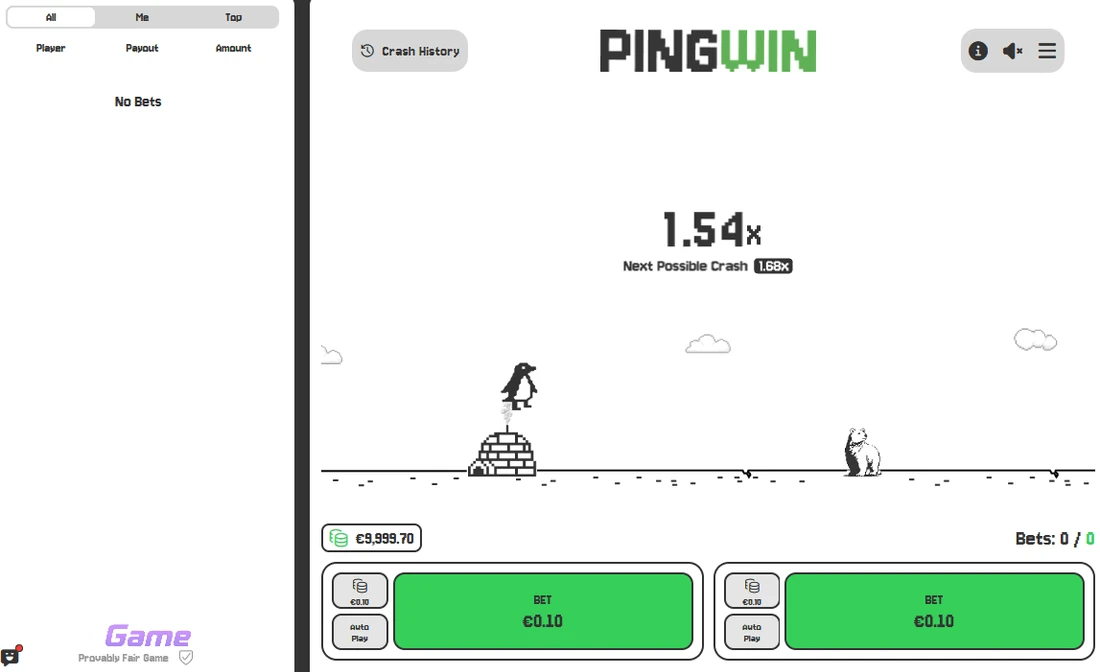
Pingwin looks fantastic. Its minimalist black-and-white graphics resemble an early mobile game from the beginning of the 2000s, complete with a tiny character and a route built from simple monochrome shapes.
The comparison with an old Nokia game is immediate. The limited palette, compact animation and uncomplicated scenery create exactly the sort of screen that would once have appeared beside Snake in a phone’s games menu.
That retro approach gives Pingwin a clear identity. Crash games regularly rely on detailed rockets, colourful aircraft or cartoon worlds, whereas XUP Studio has made something memorable from little more than a penguin, a path and a sequence of obstacles.
The character is easy to follow against the plain background. Its movement remains readable even when attention is split between the multiplier and the next hazard.
Obstacles are the most important visual elements on the screen. Their positions are obvious, allowing the player to judge how much time remains before the next potential crash.
The empty space between them is equally important. Once the penguin clears a hazard, the simplified design makes it immediately apparent that there is a safe stretch ahead.
The interface follows the same uncluttered direction. The multiplier and collection controls are easy to identify, while the monochrome route receives most of the available space.
Pingwin looks like a game that should be technically primitive, yet its presentation is perfectly suited to the mechanic. The Nokia-era style is charming, distinctive and one of the best examples we have seen of minimalism used deliberately.
Pingwin - Win Potential
Pingwin has an RTP of 97%, giving the casino a theoretical house edge of 3%.
The maximum multiplier is adjustable by the operator and is commonly set at up to 10,000x. Reaching the later values requires the penguin to survive a long sequence of obstacles.
Wagers commonly range from 0.10 to 200. The precise monetary limits and maximum multiplier should be checked through the information panel provided by the casino.
The obstacles reveal where the result may occur, but they do not show whether the penguin will survive. Each encounter is still determined by the game’s generated outcome.
What the player can control is the timing of the collection. Because the penguin does not crash between obstacles, it is possible to wait through the safe section and collect shortly before the next hazard.
That brings a genuine element of manual skill to Pingwin. Reacting too early sacrifices some of the multiplier, while reacting too late can leave the bet active when the character reaches the obstacle.
Connection speed, screen responsiveness and reaction time can therefore affect where a manual collection instruction is submitted. They cannot influence whether the penguin survives the obstacle itself.
Claim Half allows part of the return to be secured before confronting another hazard. The active remainder continues increasing and will be lost if the penguin crashes before it is collected.
Mystery Drops add the possibility of free bets. Claiming one does not make the penguin more likely to survive or change the RTP of the standard journey.
Is Pingwin Provably Fair?
Pingwin supports provably fair round verification through cryptographic result information.
The system creates a commitment to concealed round data before play begins. After the journey has finished, the relevant seed and hash information can be inspected to confirm that the result was not replaced during the round.
Players should select the completed journey through the fairness or history panel and follow the verification instructions supplied there.
The location of the obstacles is visible during play, but the concealed data determines whether the penguin survives each potential crash point. The hash cannot reveal that outcome in advance.
What we like
- Visible obstacles show exactly where each potential crash can occur
- Safe sections allow skilled manual collection immediately before the next hazard
- The monochrome Nokia-style presentation looks distinctive and superb
What we don't like
- The stripped-back black-and-white design will be too basic for some players
The bottom line
Pingwin offers something completely outside the crash-game norm by placing visible obstacles along the penguin’s route. Knowing the character is safe between hazards shifts attention away from an invisible crash point and towards the narrowing opportunity to collect. Players cannot influence whether the penguin survives, but timing a cash-out immediately before the next obstacle introduces a genuine test of judgement.
The result feels closer to an arcade game than a traditional crash title, encouraging players to watch the route rather than focus entirely on the multiplier. Its black-and-white graphics recall an early-2000s Nokia game and give Pingwin enormous personality. The distinctive art style and timing-based interaction refresh the familiar formula without burying it beneath unnecessary complexity.
Frequently Asked Questions
Pingwin has an RTP of 97%, producing a theoretical house edge of 3%.
The maximum is adjustable by the operator and is commonly configured at up to 10,000x. Check the game information for the limit applied by the casino.
Skill affects manual collection timing because the penguin cannot crash between visible obstacles. It does not determine whether the character survives when it reaches an obstacle.