Crash Game RTP and House Edge Explained
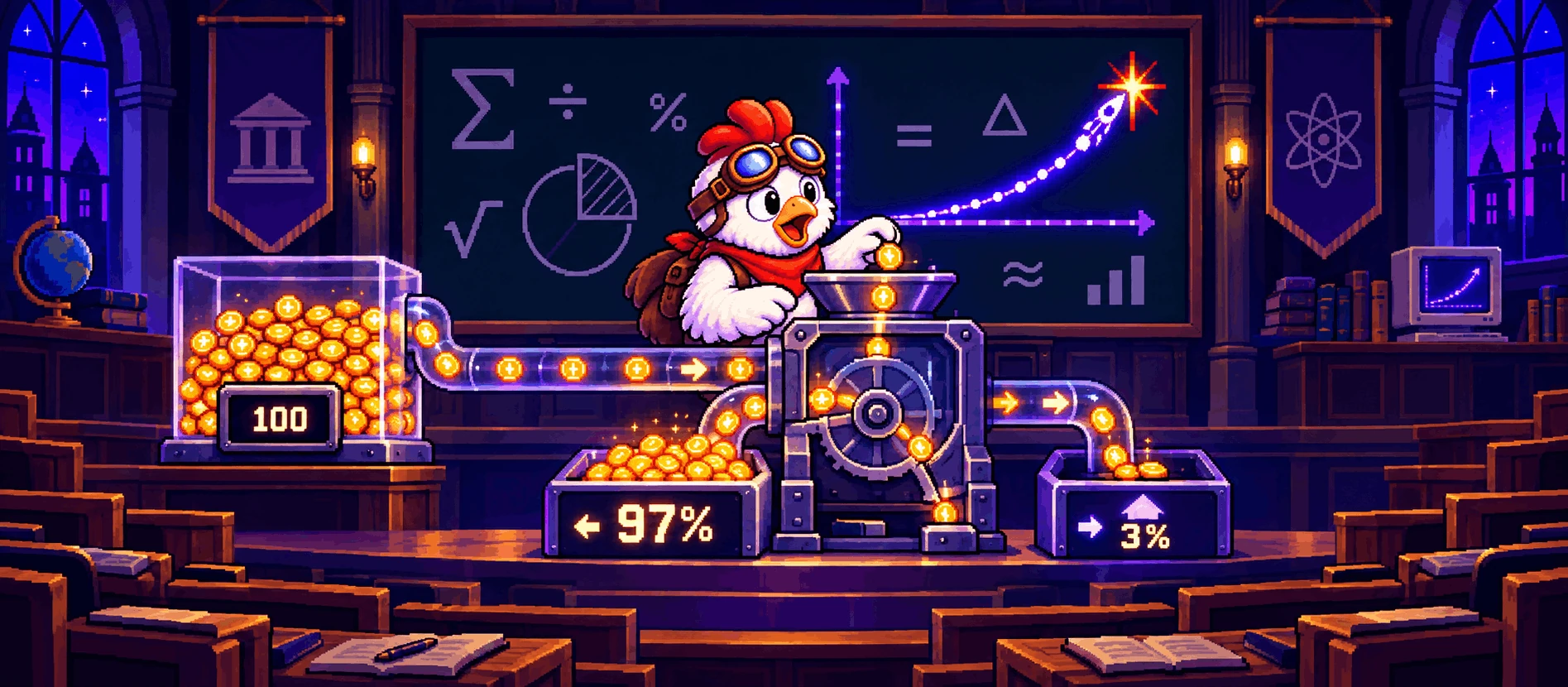

The multiplier may be the most noticeable number in a crash game, but it is not necessarily the most important. That distinction belongs to the game’s return to player, commonly shortened to RTP.
RTP tells you how much of all the money wagered a game is theoretically designed to return as prizes over the long term. House edge describes the portion it is expected to retain. Together, they reveal more about the underlying value of a crash game than its theme, maximum multiplier or number of features.
A game with 97% RTP is not promising to return 97 from every 100 you spend. It is describing a mathematical expectation measured across an enormous amount of play. Your own results can finish far above or below that percentage.
This guide explains how the two figures work, how they are built into a crash-game curve and why changing your cash-out target usually changes the experience rather than the underlying advantage.
Crash game RTP in 30 seconds
The essential points are:
RTP is the game’s theoretical long-term return. A 97% RTP represents an expected return of 97 units for every 100 wagered across the game’s complete mathematical cycle.
House edge is the other side of the calculation. A 97% RTP produces a 3% house edge.
RTP is calculated from stakes, not your initial deposit. The same funds can be wagered more than once, increasing your total turnover.
RTP does not describe one session. A player could finish considerably ahead, lose the full amount they started with or land anywhere in between.
A higher RTP is mathematically preferable when everything else is equal. It still cannot guarantee a better result during an individual visit.
The basic relationship is:
House edge = 100% − RTP
For a game with 97% RTP:
100% − 97% = 3% house edge
What does RTP actually measure?
Return to player is the expected percentage of total stakes that a game returns through payouts over the long term.
Independent testing laboratory Gaming Laboratories International explains that RTP can be calculated through a theoretical evaluation, a simulation or a combination of the two, depending on the type of game. Its mathematicians examine the game’s rules, possible outcomes and payout structure to confirm the expected return.
The important word is “expected”. RTP is part of the game’s mathematical design rather than a prediction of what will happen to one person.
Imagine that 500 units are successfully wagered through a game with 97% RTP. The long-term expectation would be:
Total amount wagered: 500
Theoretical amount returned: 485
Theoretical amount retained through the house edge: 15
An individual player is extremely unlikely to receive those exact results from a short sequence of rounds. The calculation becomes more representative as the total amount of comparable play increases, although random variation never disappears entirely.
RTP applies to turnover, not your starting balance
One of the easiest RTP mistakes is applying the percentage only to the amount deposited.
If you begin with 100 units and place 5-unit bets, your money may be returned and wagered again many times. Completing 100 bets would produce total turnover of 500 units, even though you originally started with 100.
At a 3% house edge, the theoretical cost attached to 500 units of turnover is 15 units:
500 × 0.03 = 15
This remains a long-term average rather than a session forecast. It demonstrates why the pace of play matters, however. A fast game can generate a considerable amount of turnover from a relatively modest starting balance.
What is the house edge in a crash game?
House edge measures the game’s mathematical advantage over the player. It is normally the difference between 100% and the published RTP.
Examples include:
98% RTP equals a 2% house edge
97% RTP equals a 3% house edge
96% RTP equals a 4% house edge
95% RTP equals a 5% house edge
The percentage is applied through the game’s probabilities. It is not a visible fee removed from every bet.
A one-point difference in RTP can appear small, but the effect becomes more meaningful when comparing house edges. Moving from 98% RTP to 96% RTP doubles the theoretical house advantage from 2% to 4%.
Across 1,000 units of total stakes, that would change the expected long-term cost from 20 units to 40. Actual results across those wagers could still be much higher or lower.
How is the house edge built into a crash-game curve?
Traditional crash games commonly balance the probability of reaching a multiplier against the amount it pays.
Under a standard fixed-edge crash model, the approximate probability of reaching a chosen multiplier can be expressed as:
Probability of reaching multiplier M = RTP ÷ M
For an illustrative game with 97% RTP, the approximate probabilities would be:
1.50x: 97% ÷ 1.50 = 64.67%
2.00x: 97% ÷ 2.00 = 48.50%
5.00x: 97% ÷ 5.00 = 19.40%
10.00x: 97% ÷ 10.00 = 9.70%
100.00x: 97% ÷ 100.00 = 0.97%
The potential payout grows at the same time as the probability of reaching it falls.
A target of 2.00x would produce an expected gross return of:
0.485 × 2.00 = 0.97 units per unit staked
A target of 10.00x gives the same result:
0.097 × 10.00 = 0.97 units per unit staked
The expected return is 0.97 units in both examples, equivalent to 97% RTP. One target succeeds more frequently with smaller returns, while the other produces longer losing sequences and larger occasional payouts.
This inverse relationship is examined in the 2026 paper Cash or Crash: Return to Player Percentages and Expected Value of Crash Games, published in the UNLV Gaming Research & Review Journal.
The formula above explains the conventional fixed-edge crash model. It should not be treated as a universal calculator for every title. Rounding rules, instant crashes, maximum multipliers, bonus features, stepper mechanics and alternative RTP configurations can all affect the exact distribution.
Does your cash-out multiplier change the RTP?
In a conventional crash game with a consistent house edge, selecting a different fixed cash-out point changes hit frequency and volatility rather than the theoretical RTP.
A lower target generally means:
More frequent successful cash-outs
Smaller returns when the target is reached
Shorter average losing sequences
A single failed round can remove the profit from several small wins
A higher target generally means:
Less frequent successful cash-outs
Larger potential returns
Longer losing sequences
Greater variation between short-term results
Neither approach removes the house edge.
Auto cash out does not create a mathematical advantage either. It instructs the game to attempt to settle a bet automatically if the selected multiplier is reached. This can make a target easier to follow consistently, but the wager still loses when the game crashes first.
Manual cash out gives the player more freedom during the round. Pressing the button does not influence the crash point or reveal where it will occur.
You can learn more about the basic betting process in our What Are Crash Games and How Do They Work? guide.
Why short sessions rarely resemble the published RTP
Crash games can produce particularly uneven short-term results because very large multipliers occur infrequently.
Using the simplified 97% model, a 100.00x target would be reached in approximately 0.97% of rounds. Even after 100 rounds, the calculated probability of never reaching 100.00x would still be roughly 38%.
Another player could encounter the multiplier almost immediately. Neither result changes the theoretical RTP of the game.
The Gambling Commission’s explanation of return to player similarly stresses that RTP is an average achieved over a significant number of plays, rather than on each occasion a game is played.
Testing and monitoring also have to account for volatility. A live game’s measured return can sit above or below its designed RTP for a period without proving that the underlying mathematics has changed.
RTP, hit rate and volatility are different
These terms describe separate parts of a crash game:
RTP measures the proportion of total stakes theoretically returned over the long term.
House edge represents the game’s expected mathematical advantage.
Hit rate describes how frequently a particular winning outcome occurs. In a traditional crash game, your selected cash-out target can influence how often your wager succeeds.
Volatility describes how widely results can fluctuate. Chasing high multipliers creates a more volatile pattern than repeatedly targeting a low multiplier.
Maximum multiplier is the highest multiplier the game can theoretically reach or award.
Maximum win is the largest total payout permitted from a wager. It may be restricted separately from the maximum multiplier.
A crash game can advertise a huge maximum multiplier while carrying a lower RTP than a game with a much smaller ceiling. Maximum potential and long-term return should therefore be compared separately.
Can the same crash game have different RTP settings?
Yes. Some developers publish an RTP range because a game can be supplied in more than one mathematical configuration.
A good example is SmartSoft Gaming. The studio lists an RTP range from 96.2% to 98.9%. for JetX Those configurations correspond to house edges ranging from 3.8% to 1.1%.
Galaxsys similarly lists Limbo Crash with possible RTP settings between 96.5% and 98%.
This is why the number displayed inside the game at the casino matters most. A provider page or review can identify the available RTP, but the version you open may use a different configuration within that range.
Before placing a bet:
Open the game’s menu.
Look for Rules, Help, Information or Paytable.
Find the RTP or theoretical return entry.
Check for separate RTP figures attached to different modes or features.
Confirm the maximum multiplier, maximum win and any other payout restrictions.
If the information is missing or difficult to understand, consider choosing a game that explains its mathematics more clearly.
Does a provably fair game still have a house edge?
Yes. Provably fair technology and RTP answer different questions.
A provably fair system can allow a player to verify that a completed result was derived from the committed seeds or hashes. RTP explains the expected return produced by those results over time.
A game can therefore be verifiably fair while retaining a 1%, 3% or larger house edge. “Fair” means the stated system generated the result as promised. It does not mean the game pays at 100% RTP.
The same distinction applies to certified RNG games. Independent testing can confirm that an RNG is unpredictable and that the implementation matches the published mathematics. It does not remove the mathematical advantage built into those rules.
GLI’s explanation of RNG testing outlines checks covering seeding, distribution, predictability and possible bias.
How are published RTP figures checked?
Testing requirements vary between jurisdictions, so there is no single worldwide process covering every crash game.
Independent laboratories can review source code, mathematical documentation, game rules, random number generation and simulations. The objective is to confirm that the implemented game behaves like the model described by its developer.
Great Britain provides one publicly accessible example. Its Remote Technical Standard 3 requires relevant games to make the house edge, RTP or probability of winning available before a customer gambles. Its random-outcome standard also requires results to be acceptably random and unpredictable.
Regulated does not automatically mean high RTP. It should mean that the game follows the rules and disclosure requirements of the relevant jurisdiction. Players still need to compare the percentage offered by each title and configuration.
Common crash game RTP myths
“A 97% RTP means I will win 97% of rounds”
RTP measures the value returned, not the number of winning rounds. A game could produce many small successful cash-outs or a much smaller number of large payouts while achieving the same theoretical return.
“The game has been crashing early, so a big multiplier is due”
Previous rounds do not increase the probability of the next independent result. A history panel describes the past rather than forecasting the future.
“Cashing out at 1.01x guarantees a profit”
Some crash games can end at 1.00x or before a chosen target is reached. SmartSoft’s JetX specifications explicitly identify an explosion at 1.00x as a possible loss. One failed wager can also remove the profit generated by numerous very small cash-outs.
“The game with the highest multiplier has the best RTP”
Maximum multiplier describes the potential size of an individual payout. RTP measures expected long-term value. The two figures are not interchangeable.
“Two betting panels improve the return”
Placing two bets creates two separate amounts of turnover. Different targets can change the shape of the results, but they do not automatically improve the mathematical return.
How to compare crash game RTPs properly
When comparing games, ask:
What RTP is displayed inside the playable version?
Is the title available with multiple RTP configurations?
What house edge does that percentage produce?
Does the game use a traditional curve, stepper format or bonus-driven structure?
Are partial cash out, jackpots or other features included in the quoted RTP?
What are the maximum multiplier and maximum-win limits?
How quickly could the game generate additional turnover?
Is the game tested for the jurisdiction in which it is being offered?
Does it include a player-facing provably fair verifier?
Our crash games reviews list the RTP and maximum multiplier alongside our assessment of gameplay, features, design and value. You can also compare developers through the crash games provider directory.
RTP is a comparison tool, not a session promise
A higher RTP reduces the game’s expected cost per unit wagered, but it cannot predict the result of your next round.
The amount staked and the speed at which it is wagered matter just as much. A simple way to estimate theoretical cost is:
Expected long-term cost = total amount staked × house edge
Setting spending and time limits before playing prevents the pace of a crash game from quietly increasing your turnover. Never chase losses or treat RTP as a reason to continue playing. Our responsible gambling page provides further information and links to support.